
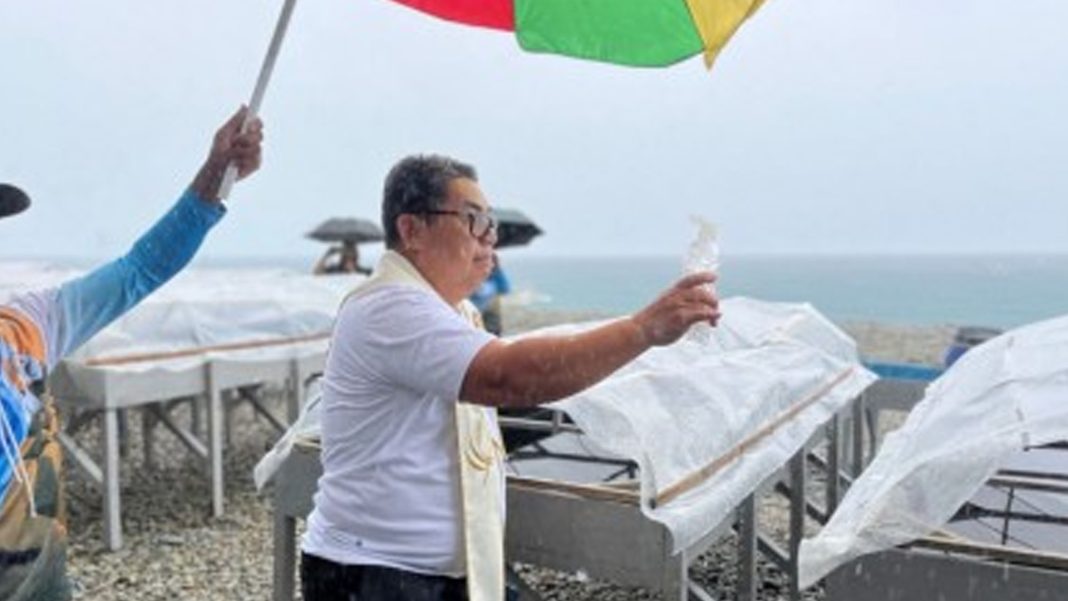






To improve coastal livelihood and support salt self-sufficiency, the Bureau of Fisheries and Aquatic Resources-Caraga Region (BFAR-13) launched three salt production initiatives in November, benefiting fisherfolk communities in Surigao del Sur and Surigao del Norte.
The PHP1.7-million initiative, carried out in partnership with the Department of Agriculture and local government units, aims to provide sustainable income sources for fisherfolk families through solar-powered salt production.
The first of the three projects was turned over to the San Roque Payapay Fisherfolk Association (SRPFA) in Lingig, Surigao del Sur on Nov. 17.
Valued at PHP673,000, the facility comprises 30 salt beds, four solar dryers and a water pump.
“Our initial operation yielded about 36 one-kilogram packs of salt,” SRPFA chairperson Larry Susada said in an interview Tuesday.
With 52 active members, the group expects to harvest up to 120 kilograms of salt per weekly cycle.
“This is an additional income for us and we are determined to grow our enterprise,” Susada added.
On Nov. 24, two more projects were handed over in Malimono, Surigao del Norte to the Hanagdong Salt Producers Association (HSPA) and Cagtinae Fisherfolk Association (CFA).
The PHP1.12 million investment provided each group with 25 elevated solar salt platforms and multiple solar dryers — three for CFA and four for HSPA.
Both associations have previously engaged in small-scale salt production earlier this year.
Before the expansion, each operated 25 salt beds with weekly outputs of about four kilograms. With the new infrastructure, CFA now reports a weekly production of 30 kilograms, while HSPA yields 27 kilograms.
“Our group will work to sustain this project as this is a good opportunity to increase our income and provide additional supply of salt in markets here in the province and the nearby towns,” CFA chairperson Arnel Publico said.
BFAR-13 said the projects were designed not only to boost production, but also to improve market linkages and explore tourism potential in coastal communities.
“These salt production projects will continue to serve as catalysts for livelihood expansion, improved income, and regional salt self-sufficiency,” the agency said in a statement. (PNA)

