





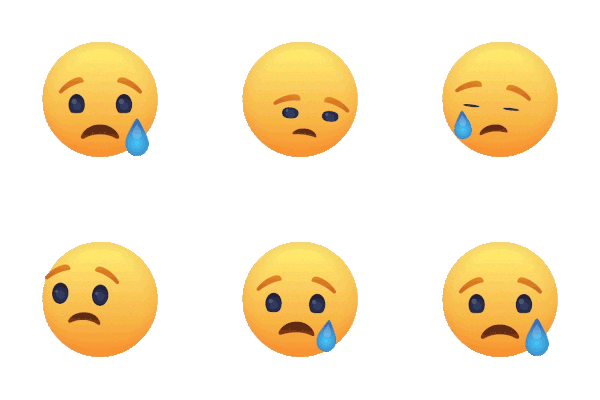

There is a quiet moment many Filipinos now recognize, usually late at night, when the phone is already in hand and the screen is glowing, but the instinct to scroll has slowed into hesitation. You see a headline, maybe political, maybe about health, maybe about the economy, and instead of reacting, sharing, or even reading closely, you pause and sigh. It is not that you do not care anymore, because you do, deeply, but caring has become tiring in a way that is hard to explain to anyone who has not lived inside this constant stream of information. This is not apathy and it is not ignorance, and it is certainly not indifference to truth. It is something more human and more dangerous, a kind of collective exhaustion that comes from having to question everything, all the time, with no clear place to rest your trust.
When Doubt Becomes a Daily Habit
For years, the national conversation around misinformation framed Filipinos as victims of fake news, as if the problem was simply about believing the wrong things. The assumption was that once people were educated enough, fact-checked enough, or warned enough, truth would naturally rise above the noise. But what we are seeing now is a more complicated reality, where many Filipinos are no longer easily fooled, yet are no longer energized to verify either. Doubt has become a daily habit, and like all habits that require effort, it eventually becomes draining rather than empowering.
In households, offices, and even group chats, conversations now come with disclaimers before opinions are shared. Someone will say, “Hindi ko sure kung totoo ‘to,” before forwarding a post, almost as a ritual of self-protection rather than responsibility. The act of questioning, which once felt like critical thinking, has started to feel like unpaid labor imposed on every citizen. When every claim requires research and every source demands skepticism, the mental load quietly piles up until disengagement feels like the only form of rest.
This fatigue is amplified by the speed of digital platforms like Facebook and TikTok, where information arrives stripped of context and optimized for emotion rather than understanding. Content is designed to provoke reaction, not reflection, and even truthful information is often packaged in ways that feel manipulative or exaggerated. Over time, people stop asking whether something is true or false and start asking a simpler, more telling question: is this even worth my energy today. When that shift happens at scale, the damage goes far beyond any single viral post.
The Emotional Cost of Being “Woke” All the Time
There was a period when being informed felt empowering, almost like a badge of civic pride. To be updated, vocal, and opinionated was seen as a sign of engagement and intelligence, especially among younger Filipinos navigating social and political awakening. But constant awareness without clear resolution has an emotional cost that is rarely acknowledged in public discourse. The pressure to have an opinion on everything, and to defend that opinion against misinformation and hostility, has turned awareness into a form of emotional labor.
This is particularly evident during election seasons, public health crises, or moments of national controversy, when timelines are flooded with competing narratives. People are not just consuming information, they are bracing themselves against it, anticipating conflict, judgment, or correction with every post. The result is a subtle but persistent anxiety that makes engagement feel risky rather than rewarding. Over time, many choose silence, not because they have nothing to say, but because saying anything feels exhausting.
Studies on information overload have shown that constant exposure to conflicting data increases stress and reduces decision-making confidence (psychologytoday.com). In the Philippine context, where social media is deeply intertwined with personal relationships, this stress is magnified. Disagreeing with a post is not just an intellectual act, it can feel like a social betrayal, especially when misinformation comes from family or close friends. Choosing not to engage becomes a way to preserve relationships, even if it means stepping back from public discourse altogether.
When Trust Becomes the Real Casualty
The most troubling consequence of misinformation fatigue is not confusion, but erosion of trust. Trust in media, trust in institutions, trust in experts, and eventually trust in one’s own ability to discern truth. When everything is suspect, nothing feels solid, and skepticism turns inward. People begin to doubt not just the information they see, but their own judgment in evaluating it.
This erosion is visible in how Filipinos talk about news organizations like Rappler or government bodies like Commission on Elections, where even verified reports are often met with accusations of bias before content is even read. While healthy skepticism is essential in a democracy, blanket distrust creates a vacuum where facts struggle to land. In that vacuum, misinformation does not even need to convince, it only needs to confuse.
The tragedy here is that many Filipinos are not rejecting truth, they are retreating from the effort required to find it. When trust collapses, people rely more on personal intuition or community consensus, which can be comforting but dangerously insular. This is how echo chambers persist, not because people want to be misled, but because familiarity feels safer than constant doubt. In a country where communal ties are strong, this dynamic shapes not just opinions, but identities.
The Quiet Shift From Engagement to Withdrawal
One of the least discussed outcomes of misinformation fatigue is withdrawal, a slow disengagement from civic life that does not announce itself loudly. People stop reading long articles, stop watching news programs, and stop participating in discussions that once mattered to them. They may still scroll, still like, still react, but the deeper forms of engagement quietly fade away.
This withdrawal is often mistaken for contentment or acceptance, when it is closer to burnout. Filipinos are resilient, but resilience should not be confused with infinite capacity. When every crisis is framed as urgent and every issue demands immediate moral clarity, people protect themselves by narrowing their focus to what feels manageable. Family, work, and personal survival take precedence, while national conversations become background noise.
The danger is that this silence creates space for louder, more extreme voices to dominate discourse. When reasonable people step back, not because they agree, but because they are tired, the information ecosystem becomes skewed. This is not a failure of intelligence or values, but a failure of systems that place the burden of truth entirely on individuals. Expecting citizens to constantly self-police information without institutional support is unsustainable, no matter how digitally savvy a population may be.
Rebuilding Energy, Not Just Literacy
The next phase of addressing misinformation in the Philippines cannot rely solely on media literacy campaigns or fact-checking initiatives, important as they are. What is equally needed is an understanding of emotional and cognitive fatigue, and a commitment to designing information environments that respect human limits. Trust cannot be rebuilt through correction alone, it must be rebuilt through consistency, transparency, and empathy.
Media organizations, platforms, and institutions must recognize that clarity is a form of care. Simplifying messages, providing context, and acknowledging uncertainty where it exists can reduce the emotional load on audiences. When people feel respected rather than lectured, engagement becomes possible again. The goal should not be to make Filipinos hypervigilant consumers of information, but confident ones who know where to turn without feeling overwhelmed.
At a societal level, there is also room to normalize stepping back without shame. Being informed does not have to mean being constantly online or perpetually outraged. Rest is not disengagement, it is preservation. A healthier information culture allows people to pause, reflect, and re-enter conversations with renewed clarity rather than chronic exhaustion.
The real challenge, then, is not just fighting fake news, but addressing the quieter crisis of trust fatigue that lingers even after falsehoods are debunked. If Filipinos are to re-engage meaningfully with truth, they must first feel that truth is reachable without costing them their peace. How do we design systems that make trust less tiring to maintain. How do we reward clarity over noise. And how do we help people feel that caring about what is true does not have to mean carrying the weight of the world every single day.