


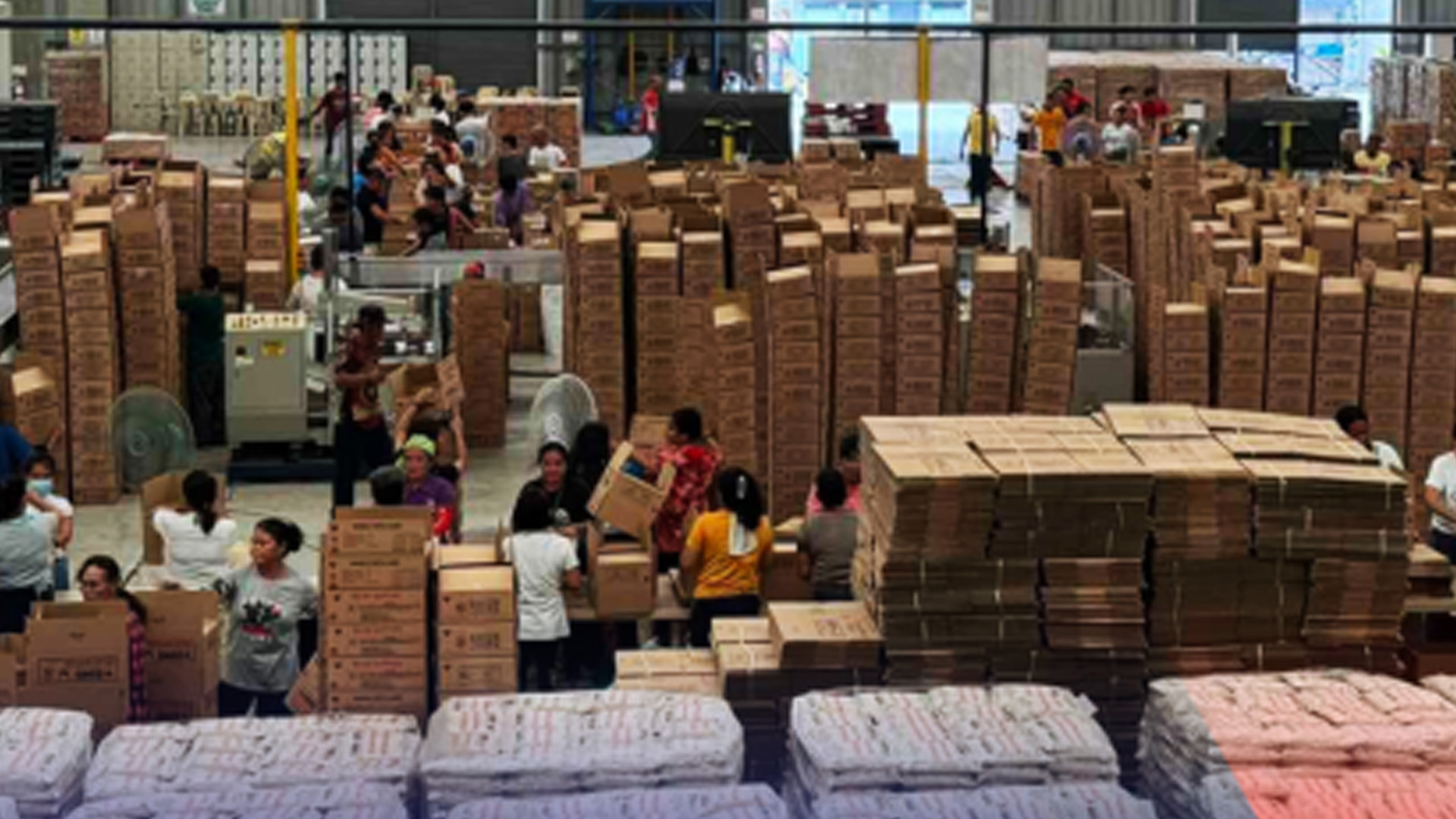






In line with the efforts to ensure that no disaster-affected family will go hungry under the Marcos Administration, the Department of Social Welfare and Development’s (DSWD) National Resource and Logistics Management Bureau (NRLMB) has achieved another milestone by producing 3.3 million family food packs (FFPs) as of Saturday.
DSWD Secretary Rex Gatchalian congratulated the NLRMB on the production milestone and directed Assistant Secretary Leo Quintilla, NLRMB Officer-in-Charge, to work towards reaching the 4-million mark at the earliest possible time.
“In the DSWD, we continue to enhance our production capacity to guarantee that we always have sufficient goods prepositioned in all our hubs, spokes, and last mile warehouses across the country. This is aligned with the Department’s Buong Bansa Handa (BBH) program,” Quintilla said in a news release.
The senior official of the DSWD’s Disaster Response Management Group (DRMG), who oversees the DSWD’s main production hubs in Pasay City for Luzon and Mandaue City for the Visayas, explained that the BBH employs two parallel supply chains for disaster preparedness and response.
“The BBH initiative has a government-led supply chain at the national and local levels. We tap local governments to house stockpiles so these goods can be deployed quickly when needed. Meanwhile, we also maintain a private sector–driven supply chain, engaging private partners through framework agreements to leverage their expertise and resources,” he said.
Apart from the BBH, he said the DSWD also continues to innovate in terms of its disaster preparedness and response capabilities.
Through its mechanized production system located at the Luzon Disaster Resource Center in Pasay City and the Visayas Disaster Resource Center in Mandaue City, the DSWD can produce between 18,000 and 20,000 FFPs per day.
“This capacity ensures that, even in the absence of a disaster or emergency, we remain ready to replenish stocks and rapidly deploy relief goods when needed,” Quintilla said.
The mechanized production also utilizes a barcoding system to track the expiration dates and delivery of the FFPs, he said.
“We also use an inventory management system to monitor this information, enabling us to identify the appropriate warehouse for storage and prioritize items for immediate distribution,” he said.
Quintilla said the DSWD is also looking to establish a Mindanao Disaster Resource Center in Butuan City in 2026 as part of the regional initiatives under the BBH program.
The MDRC project will begin this year with an initial budget of PHP500 million under the approved DSWD budget in the 2026 General Appropriations Act (GAA).
Another innovation that the DSWD plans to implement this year is the iron-fortified rice production.
“By using this innovation in our supply chain, the DSWD hopes to boost the nutritional value of rice in our relief operations, helping fight iron deficiency anemia and support food security for vulnerable communities,” Quintilla said.
On Jan. 27 to 29, the NRLMB conducted a workshop with the Department of Science and Technology (DOST) – Food and Nutrition Research Institute (FNRI) and the National Food Authority to discuss the technical use of DOST-FNRI’s specialized blending technology. (PNA)